
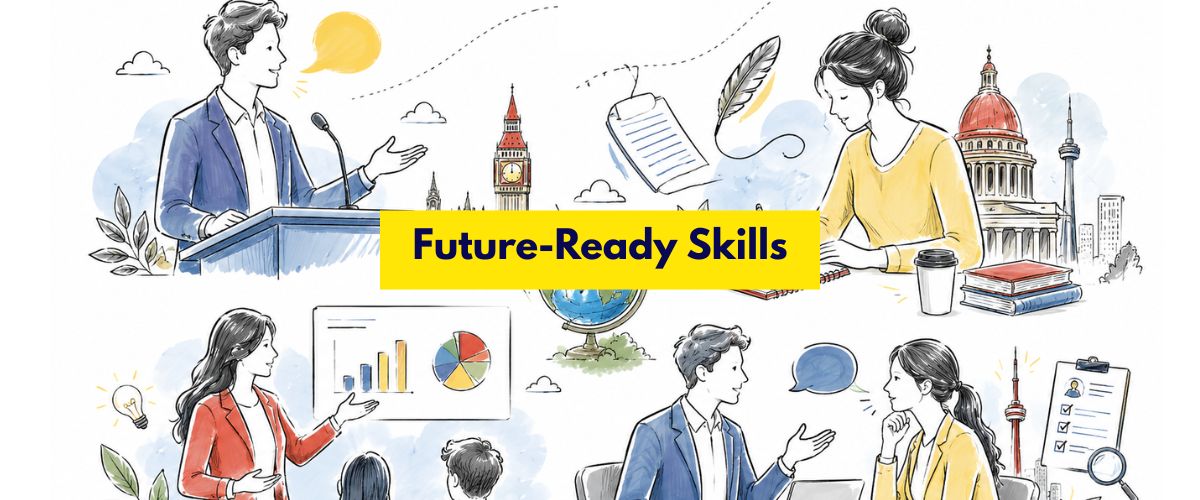
Not every important conversation happens from a stage. Some happen in everyday situations where ideas have to be communicated with clarity and conviction. Some happen in an interview room where a candidate has only a few minutes to leave an impression. Some happen in meetings, presentations, discussions, negotiations, and everyday moments when people are called upon to explain what they think and why it matters.
The ability to speak well is often mistaken for confidence. In reality, it begins much earlier—with clarity of thought. At Mindmap, public speaking is not approached as performance. It is approached as communication in its broadest sense: learning how to organise ideas, express them meaningfully, listen actively, respond thoughtfully, and speak in a way that people remember.
Participants learn to move beyond memorised speeches and prepared answers. They learn to think on their feet, build compelling narratives, ask better questions, engage with different audiences, and communicate with both conviction and nuance. The programme combines structured speaking exercises, discussions, presentations, debates, storytelling, impromptu speaking, and personalised feedback. Every session is designed to create opportunities for participants to speak, reflect, refine, and grow. Over time, many discover that the most significant transformation is not simply becoming a better speaker. It is becoming someone who can articulate ideas with greater clarity, participate more confidently in important conversations, and engage more meaningfully with others. In a world filled with information, the ability to communicate an idea remains one of the most enduring forms of influence.
Academic writing is more than the ability to write well. It is the ability to investigate a topic, evaluate information, develop an argument, and communicate ideas in a clear, structured, and evidence-based manner. Our academic writing programme familiarises learners with the key stages of the academic writing process—from research and critical reading to argument development, drafting, referencing, and revision. Participants learn how to identify credible sources, synthesise information, engage with differing viewpoints, and construct coherent arguments supported by evidence.
The programme covers a range of academic formats, including essays, reports, literature reviews, research projects, reflective writing, and personal statements. Particular emphasis is placed on organisation, academic style, citation practices, and maintaining academic integrity. Through guided exercises, writing workshops, and personalised feedback, learners strengthen their ability to analyse information, communicate complex ideas effectively, and present their work with clarity and precision. Whether preparing for school projects, university applications, undergraduate coursework, or research-based study, participants develop a foundation that supports both academic success and lifelong learning.
Creative writing combines imagination with craft. It involves observing the world closely, developing ideas, shaping narratives, and using language purposefully to engage a reader. Our creative writing programme introduces learners to the fundamental elements of storytelling, including character development, narrative structure, dialogue, setting, point of view, description, and voice. Participants explore how stories are built, how characters are developed, and how language can be used to create atmosphere, tension, and meaning.
The programme covers a selection of creative forms, including short fiction, personal narratives, poetry, travel writing, descriptive writing, and creative non-fiction. Equal emphasis is placed on idea generation, drafting, revision, and constructive critique, helping learners understand that effective writing emerges through a process of refinement. Through reading, writing exercises, workshops, and guided feedback, participants develop greater control over their writing while expanding their capacity for observation, expression, and storytelling. Whether writing for personal enjoyment, competitions, publications, portfolios, or future academic pursuits, learners gain the tools to communicate experiences, ideas, and perspectives with originality and purpose.
An interview is more than a series of questions and answers. It is an opportunity to communicate experiences, demonstrate suitability, and engage thoughtfully in a professional conversation. The interview preparation programme at Mindmap helps participants understand the purpose and structure of interviews while developing the skills required to present themselves with clarity and confidence. Learners explore how to articulate their experiences, communicate achievements effectively, respond to challenging questions, and build meaningful narratives around their academic, professional, and personal journeys.
Particular emphasis is placed on self-awareness, communication, preparation strategies, professional etiquette, body language, active listening, and structured responses. Participants also learn how to adapt their communication to different interview formats and expectations.
Through mock interviews, guided practice, feedback, and reflection, learners develop the ability to respond thoughtfully, engage confidently, and communicate their strengths authentically. Whether preparing for college admissions, scholarship interviews, internships, employment opportunities, professional advancement, or student visa interviews, participants gain practical skills that support effective performance across a wide range of interview settings.
The ability to present information effectively is an essential skill across academic, professional, and leadership settings. Whether explaining a concept, sharing findings, proposing an idea, or reporting progress, a well-structured presentation enables information to be understood, retained, and acted upon. The programme focuses on the planning, organisation, and delivery of presentations. Participants learn how to identify key messages, structure content logically, design clear and purposeful visual aids, and adapt their approach to different audiences and objectives.
The programme places emphasis on content organisation, audience awareness, slide design, data and information presentation, delivery techniques, and question handling. Participants also learn how to balance information with engagement, ensuring that presentations remain both informative and accessible. Through guided practice, presentation exercises, and constructive feedback, learners develop the ability to communicate information with clarity, coherence, and confidence. Whether presenting academic projects, research findings, business proposals, case studies, or professional updates, participants gain practical skills that support effective communication in a wide range of settings.
436, 4th B Main, HRBR 2nd Block Kalyannagar Bangalore 560043 INDIA.

Mindmap is a platform that provides the right tool kit to every student. It empowers them with credible info about their career spectrum,